Warehouse Management System for Food Industry: Why Food Manufacturers Need More Than Generic WMS
A warehouse management system for food industry has to handle catch-weight every minute, enforce expiry rules at picking time, and stay in sync with production and quality. Generic WMS does the first job. Food-native WMS does all three.

Why generic WMS breaks in food manufacturing
Generic WMS assumes the warehouse looks like a clock. Twelve thousand units of SKU A, then four thousand of SKU B, predictable expiry, fixed weights. Food manufacturing rarely behaves like that.
Variable weight breaks fixed-quantity inventory
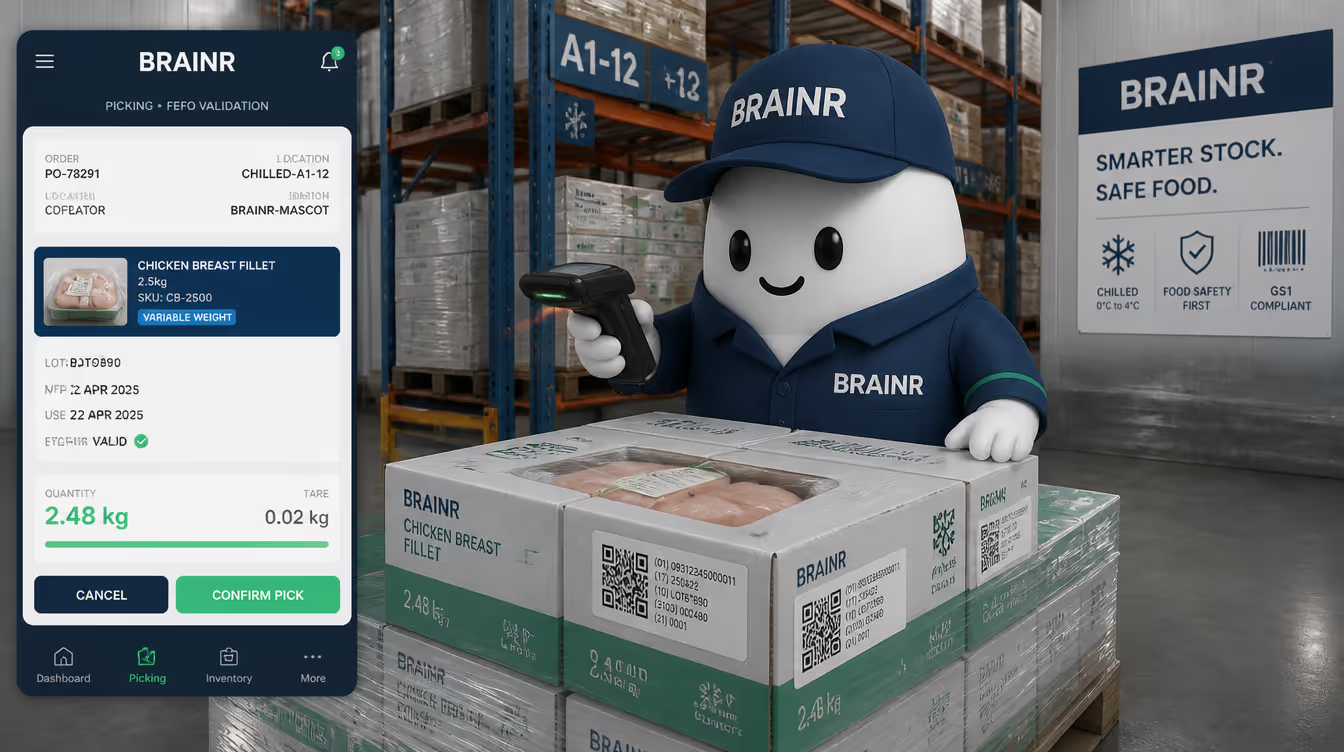
In meat, poultry, fish and fresh-cut, every unit weighs something different. A 1.6 kg whole chicken is a target weight, not an actual one. Stock has to be expressed in pieces and in kilograms at the same time, and every catch-weight scan during picking has to confirm three things at once: lot, weight, expiry. WMS that treats weight as a post-hoc correction loses accuracy on every dispatch. Pallets that look right by piece count fall short by kilogram, and the OTIF gap shows up at the retailer's receiving dock.
Expiry windows make FEFO non-negotiable
Shelf life is a hard constraint, not a nice-to-have. A fresh-cut salad order can't be picked from a lot that expires in two days when the customer's minimum is seven. A dairy line can't ship a yoghurt SKU on day eleven of a ten-day window. FEFO sequencing has to be enforced at the picking modal, not validated at audit time. And different retailers have different rules, some want first-to-expire first, others want a guaranteed remaining shelf life per category. A food WMS has to apply both, by product, by customer.
"Excel and Paper is still the standard on the food industry in Europe and worldwide."
Paulo Gaspar, CEO BRAINR (Webinar April 2026)
Lot integrity is a compliance baseline, not a feature
Every lot moving through the warehouse is a row in a future audit. BRC, IFS, FSMA 204, they all require one-step-back, one-step-forward traceability at lot granularity. A WMS that captures lots inconsistently across goods receipt, transfer and dispatch fails the audit not because the data is wrong, but because the audit trail is incomplete. Food WMS treats the lot as the unit of inventory, not the SKU.
Multi-temperature zones change every picking decision
Chilled, frozen, ambient, each with different storage rules, different picking sequences, different operator workflows. A pallet that crosses zones loses cold-chain integrity. A picking route that wastes time outside the chilled bay loses shelf life. Generic WMS treats zones as labels on locations. Food WMS treats zones as constraints on every movement.
What a food warehouse management system actually does
A food WMS calculates what is in the warehouse, by lot, location, expiry, state and reservation, in real time. And it controls every movement against the rules that food manufacturing imposes. Four moving parts.
Real-time stock by lot, location, expiry, state and reservation
The stock view is not just "300 cases of SKU A in zone B". It is "lot 2026-04-12, 287.4 kg net, expires 2026-06-05, in chilled bay B-04-12, reserved for SO-44921 with customer's minimum days-to-expiry rule of 30 days, weight tolerance plus or minus 50g per unit". A picker sees the same view as the planner. A dispatch manager sees what has been reserved before the truck arrives. ERP reconciliation happens in real time, not via overnight batch jobs.
Goods receipt with mobile QC, weight capture and supplier-document validation
At the dock, every pallet is scanned, weighed and validated. Mobile QC checks (temperature, packaging integrity, count vs supplier ASN) are captured directly into the warehouse record. Weight tolerance per supplier is validated against the purchase order, and discrepancies are flagged before the truck leaves. For variable-weight items like alheiras or whole birds, each box gets its own batch with its specific weight; fixed-weight items batch in bulk. No paper goods-received notes. No retroactive corrections at month-end.
GS1-driven picking with FEFO and customer rotation rules
Picking is a GS1 workflow. Scan the SSCC on the pallet, scan the GS1 DataMatrix on the case, system validates lot, weight, expiry and SSCC in a single read. Rotation rules, FEFO, FIFO, or customer-specific, apply at the picking modal, blocking the operator from picking a lot that doesn't meet the customer's minimum days-to-expiry. Variable-weight items get their actual weight captured at scan time, not estimated. Allergen sequencing and zone constraints are baked in.
Loading, palletisation, dock control and shipping accuracy
Multiproduct pallets are built with GS1 SSCC labels validated in real time. The dock assignment knows which truck takes which orders, which orders need cross-docking, and which need intercompany transfer documentation. Loading scans confirm every pallet against the dispatch order before the truck leaves. The shipping accuracy metric, wrong lot, wrong weight, wrong customer rotation, drops to near-zero, not because operators are more careful, but because the workflow makes the wrong action impossible to commit.
WMS, ERP and MES: where the warehouse layer actually sits
A food factory typically runs four operational systems. ERP runs the business: customer orders, supplier orders, financials, master data. MES executes production. WMS handles the physical warehouse. Quality runs across all of them. The question isn't whether you need WMS. The question is where it lives.
Why ERP-native warehouse modules struggle in food factories
ERPs are great at master data and accounting. They're not great at lot-level, expiry-aware, GS1-scanned physical warehouse execution. ERP-native warehouse modules typically expect bulk SKU movements, fixed weights, and end-of-shift reconciliation. They batch goods receipt overnight, reconcile picking variance weekly, and surface stock variance at year-end. In a food factory where catch-weight variance is hourly, expiry is daily, and customer rotation rules differ by retailer, the ERP-native warehouse loses visibility within the first shift.
WMS built inside an MES/MOM platform
When the warehouse layer runs on the same operational platform as production planning, execution and quality, every stock move reads from and writes to the same live data. A QMS hold on a lot blocks the dispatch instantly. A production yield correction updates the stock balance the moment the cutting line finishes the batch. An expiry change inherits across all packs containing that ingredient. There's no integration tax, because there's no integration: it's the same system. That's how the food MES/MOM platform from BRAINR is designed, with WMS as a native module rather than a bolted-on warehouse layer.
Where the ERP still belongs
ERP keeps customer orders, supplier orders, financials and master data. The MES/MOM platform keeps real-time floor and warehouse state, lot-level traceability and shipping evidence. They talk to each other through real-time REST APIs into ERPs like SAP, Microsoft Dynamics, Primavera, PHC and Sage, not overnight batches. The ERP doesn't lose its job; the warehouse just stops trying to live inside it.
How BRAINR's WMS module is built for food manufacturers
The BRAINR WMS module is the warehouse layer inside the BRAINR food MES/MOM platform. It's built around five design choices specific to food and beverage operations.
Catch-weight and dual-unit handling across every operation
Every variable-weight box, every dual-unit SKU, every gram of weight tolerance is a first-class data point. Stock is expressed in pieces and kilograms simultaneously. Catch-weight validation runs at goods receipt, at transfer, at picking and at dispatch. The system doesn't approximate catch-weight as an inventory adjustment at month-end; it captures it at the scan.
FEFO, FIFO and customer-specific rotation rules inside picking
Rotation strategy is configurable by product or by customer. FEFO for short shelf-life items. FIFO for stable inventory. Customer-specific rotation when a retailer has a contractual minimum days-to-expiry. The rule fires at the picking modal. Operators can't pick lots that violate the rule, so dispatch errors that are caught at the retailer's dock instead become workflows that block at the warehouse, where they cost orders of magnitude less to fix.
Mobile-native Android execution on the shopfloor
Picking, goods receipt, transfers, inventory counts and dispatch all run on Android-native devices. Hardware-agnostic since release 202603, so the operator's device isn't a vendor lock-in and TCO stays in line with standard Android fleets rather than tied to one scanner brand. The mobile UX matters because shopfloor adoption is the difference between a WMS that lives in the system and a WMS that lives in spreadsheets. BRAINR reports consistently high shopfloor adoption on the WMS mobile apps across deployments.
Integration with scales, label printers, weighbridges and ERPs
Marel slaughter plans and weight integration. MTech farm-to-factory data. Bizerba and Captemp scales with automatic capture. Zebra and beyond mobile scanners. Bartender label printers driving GS1 DataMatrix variable-weight labels. SAP, Microsoft Dynamics, Primavera, PHC ERPs with real-time bidirectional flows. Weighbridges with automatic capture, tolerance validation and dock assignment. The integration list is the food factory's actual equipment stack, not a partner ecosystem that requires a new project per device.
Multiproduct pallets and GS1 SSCC labels at scale
Mixed-SKU pallets with GS1-compliant SSCC labels, validated in real time. Half-container and partial movement management. Cross-docking between plants and vehicles. Intercompany transfers with structured documentation. The pallet becomes a traceable unit, not a manual line item.
"The adoption of GS1 DataMatrix allowed us to standardise how we identify and manage variable-weight products across the entire value chain. By integrating these standards with BRAINR, we moved from fragmented scanning and manual validation to a fully automated, system-driven logistics flow." - Carlos Caldeira, CEO Lusiaves Group (GS1 case study)
WMS for poultry, meat, fish, dairy, bakery, ready meals and beverages
The same WMS engine runs across very different food verticals, but the constraints it has to handle change shape.
Poultry
Variable-weight whole birds, retail-pack SKUs by cut, Halal and organic segregation, customer rotation rules by retailer. Picking a tray of fresh chicken thighs for a UK supermarket isn't the same as picking a frozen carcass for export. WMS has to know the difference, by product and by destination. See how this works in poultry processing.
Protein: pork, beef, fish and seafood
Carcass-to-cut traceability, allergen separation, batch-to-batch chilling windows, dual-unit (carton and kilogram) inventory. The plan starts from headcount and adjusts as actual cuts come off the deboning line; the warehouse mirrors the change in seconds. More on pork and beef processing.
In fish and seafood, same-day dispatch is the default, not the exception. Cold-chain integrity from receipt to truck. Catch-weight on every unit. Expiry measured in days, not weeks. More on fish and seafood operations.
Dairy, bakery, ready meals and beverages
Short shelf-life cultures, chilled and frozen zones, recipe-driven rotation across yoghurt, milk and cream lines. CIP cycles upstream affect downstream stock. Variable-weight retail-pack SKUs combine with fixed-weight institutional packs in the same warehouse. Related: dairy production planning.
In industrial bakery, allergen rules dictate the daily sequence in the warehouse as much as on the production line. Frozen vs ambient zones for the same SKU range. Fresh production windows force same-day dispatch on most SKUs, and the warehouse becomes a high-velocity transit point rather than a holding area. More on industrial bakery.
Pre-cooked and ready meals bring multi-component pick lists where each component has its own expiry. The finished pack inherits the shortest expiry of its inputs, and the WMS has to know that at picking time, not at customer complaint time. More on pre-cooked and ready meals.
Beverages add pallet integrity across SKU-mix dispatches, dock changeover between recipes, and tank-to-bottle traceability that has to reconcile to the warehouse the moment the line stops. More on beverage operations.
Results food manufacturers measure with BRAINR WMS
Verified numbers from food factories running BRAINR WMS as part of the MES/MOM platform.
Avisabor: minus 50% storage time, minus 90% delivery failures, 40K to 190K birds/day
Avisabor runs 35 production lines, 5,200 batches per month, 1,000 production orders per month and more than 350 SKUs on BRAINR. Replacing paper records and disconnected legacy systems with BRAINR cut average warehouse storage time by 50% and delivery failures by 90%. The plant scaled from 40,000 to a peak of 190,000 birds per day on the same software, with the warehouse layer absorbing 4.75 times the throughput without re-platforming. Read the Avisabor case study.
"We often only knew too late what was arriving from the farms. This led us to errors, delays and inefficiencies." - Diogo Ferreira, Managing Director, Lusiaves Marinha das Ondas (Webinar April 2026)
Campoaves Viseu: IFS Food in 4 months, minus 94% shipping errors
Campoaves Viseu sequences 60,000 trays per day across 21 lines. The site achieved IFS Food certification four months after going live, with a 94% reduction in shipping errors and 100% digital traceability replacing paper records. Warehouse digital evidence, every receipt, every transfer, every dispatch, every lot, became the audit trail, not a separate compliance project. Read the Campoaves Viseu case study.
Lusiaves Group goods receipt: 700,000 picks/month on GS1 DataMatrix
Lusiaves Group's GS1 DataMatrix pilot encodes batch, weight, expiry, SSCC, country of origin and customer PO reference in a single 2D symbol. One scan replaced three scans. Total picking labour at the pilot plant: from 583 hours per month to 194 hours per month. Same plant, same volumes, same shift. Read the Lusiaves goods receipt case study.
Group scale
Over €1 billion of poultry production is processed through BRAINR today, with one new factory rolling onto the platform per year since 2019.
How to choose a WMS for food and beverage manufacturing
A short checklist for evaluating WMS in a food and beverage context.
Food-native constraints. Does the WMS handle catch-weight at the scan, not as an adjustment? Does FEFO fire at the picking modal, blocking lots that violate customer rules? Does the lot, not the SKU, sit at the centre of the data model? If the answer is "we integrate with a module that does that", the answer is no.
ERP and MES integration depth. Will it read sales orders, master data and goods receipt notices from your ERP without manual exports? Will it write goods receipts, picks and dispatches back in real time? Does the WMS read from the same live floor data the MES is generating, so a yield correction or a QMS hold reflects in stock immediately?
Mobile-native execution and shopfloor adoption. Will pickers and goods receipt operators actually use the device? Does the UX make the right action the easy action, and the wrong action blocked? Hardware lock-in (one brand of scanner, one brand of mobile) raises TCO and risks adoption.
Multi-site rollout pattern. If you run more than one plant, does the WMS support a phased rollout that respects local SKU ranges, zones and customer rotation rules while consolidating stock visibility for the group? Big-bang multi-plant projects fail more often than they succeed; section-by-section rollouts (Lusiaves Group has been rolling one new factory per year since 2019 on BRAINR) reach production faster and de-risk audits.
Audit-ready compliance evidence. Does the WMS deliver evidence for BRC Global Standards, IFS Food, and the FDA's FSMA 204 Food Traceability Rule as a by-product of how the warehouse runs, or as a separate compliance project? GS1 SSCC and DataMatrix standards should be native, not an add-on.
The cost of choosing wrong isn't just rollout time. It's locking the warehouse function into a tool that can't see catch weight, can't enforce FEFO, and can't talk to production and quality in real time. In food and beverage, that's most of the dispatch errors that hit the OTIF metric every month.
Frequently asked questions about WMS for food manufacturing
What is a warehouse management system for food industry?
A warehouse management system (WMS) for food industry is a software platform that controls every movement of goods through a food manufacturer's warehouse, by lot and expiry, with catch-weight and FEFO rules at the centre of the data model. It manages goods receipt with QC and weight capture, real-time stock by lot and location, GS1-driven picking with customer rotation rules, palletisation with SSCC labels, and dispatch accuracy validation.
How is a food WMS different from a generic WMS?
Generic WMS was designed for distribution: fixed quantities, stable inventory, expiry as an attribute. Food WMS treats catch-weight as a first-class data point, enforces FEFO and customer rotation rules at the picking modal, and integrates with production, quality and compliance natively rather than as a downstream system.
What is FEFO and why does it matter in food warehousing?
FEFO (First-Expiry-First-Out) sequences picking so that lots closest to expiry leave the warehouse first. In food manufacturing, FEFO is non-negotiable: it minimises write-offs, protects shelf life at the retailer, and ensures compliance with customer-specific minimum days-to-expiry rules. A WMS that enforces FEFO at the picking modal blocks dispatch errors before they leave the warehouse.
Can a WMS handle catch-weight and variable-weight products in food manufacturing?
Food-native WMS does. Catch-weight is captured at scan time, validated against the order, and integrated with both pieces-based and weight-based stock views. Generic WMS designed for distribution typically treats weight variance as a post-hoc inventory correction, not as a planning input.
How does WMS integrate with MES for food manufacturing?
The strongest integration model is when WMS and MES share one data model on the same operational platform. Production yields update warehouse stock the moment the line finishes a batch. QMS holds block dispatch automatically. Goods receipt feeds raw material availability into the MES schedule in real time. Backflush inventory updates happen automatically as production consumes raw materials, eliminating manual reconciliation. The BRAINR food MES/MOM platform uses this model.
Does food WMS support FSMA 204 and FSMA Rule 204 compliance?
A food-native WMS captures the Key Data Elements and Critical Tracking Events that FSMA 204 requires at every warehouse touchpoint: receiving, transformation and shipping. BRAINR captures lot-level data at every movement, with mobile QC at receipt and dispatch evidence per pallet, supporting the documentation FSMA 204 requires.
What does GS1 SSCC mean for food warehouse operations?
GS1 SSCC (Serial Shipping Container Code) is a global standard that uniquely identifies a logistic unit (pallet, case, container). In food warehousing, SSCC enables one-scan validation of lot, weight, expiry and customer reference per pallet, replacing the three or four separate scans a non-GS1 workflow requires. Lusiaves Group reduced picking labour from 583 to 194 hours per month on its GS1 DataMatrix pilot.
What size of food manufacturer needs a dedicated WMS?
Any food manufacturer running more than one shared bay, more than a handful of SKUs with different expiry profiles, or any product subject to customer rotation rules. The complexity that justifies dedicated WMS appears earlier in food than in discrete manufacturing.
Ready to run your food warehouse on facts, not paper?
Warehouses that ignore catch-weight, FEFO and lot integrity stay reactive. Warehouses built on real stock, real rules and real-time integration with production and quality become predictable.
See the BRAINR WMS module or book a demo to see how it runs in a working food and beverage warehouse.

Stay Ahead with Fresh Insights
Dive into our blog for stories, lessons, and behind-the-scenes insights from real projects. It’s where we share what’s working — and what we’ve learned along the way.


Frequently asked questions