Food Traceability Software for Every Food Manufacturer (2026 Guide)
What modern food traceability software actually does in 2026, what FSMA and EU rules require, and how three European manufacturers digitised in 4 months.


Most european food manufacturers still run traceability on paper, spreadsheets, and disconnected systems. The problem is not visibility during normal operations. The problem appears at a retailer audit, at a quality incident or at a recall with a customer asking where a product came from, what line produced it, and which batches were affected. At that moment, traceability stops being a compliance exercise and becomes an operational test.
Across Europe, that test is getting harder and harder to pass. Regulations like FSMA Rule 204 and stricter retailer requirements are forcing manufacturers to produce faster, more reliable records across increasingly complex operations. At the same time, food production itself has become more difficult to manage: more SKUs, shorter shelf life, multi-site flows, variable-weight products, and growing pressure on labour and margins.
This guide explains what modern food traceability looks like in 2026, what current regulations require, how food-native platforms differ from legacy systems, and how three European manufacturers achieved measurable operational improvements in four months or less.
What food traceability software is (and why one-size doesn't fit)
Food traceability software tracks and records every movement of food products across the supply chain, from raw material intake to final dispatch. It captures lot-level data at every transformation step, so any product can be traced backward (where ingredients came from) and forward (where finished goods went).
This is the textbook definition. It is also why most software fails when applied to real food operations.
A traceability system designed for general manufacturing assumes batches of identical units, fixed recipes, and predictable flows. Food production violates all three. A poultry slaughter line generates dozens of co-products from one input. A dairy plant manages catch weight on every package. A fresh-cut producer rotates 1,000+ SKUs through small daily orders with shelf life measured in days, not weeks.
Two concepts matter:
- Upstream tracing (backward traceability): tracking where each ingredient or raw material came from, including supplier, lot, certifications and treatment.
- Downstream tracing (forward traceability): tracking where each finished product went, including customer, route, batch, expiry date and shelf life.
Strong platforms do both, automatically, without manual reconciliation between systems. Weak systems do one well and leave the other to spreadsheets.
The hard test is not whether software can produce a traceability report. It is whether the report is correct, whether it covers the entire genealogy from origin to dispatch, and whether it is generated in minutes, not days.
The regulatory landscape: FSMA, BRC, IFS, GFSI
Modern food traceability software does not exist in a vacuum. It exists because regulators, retail buyers, and certification bodies demand traceability that paper-based processes cannot deliver under audit pressure.
Four frameworks shape what good software has to support:
FSMA Rule 204 (United States)
The FDA's Food Traceability Rule requires manufacturers handling foods on the Food Traceability List (FTL), which covers leafy greens, soft cheeses, fresh-cut produce, shell eggs, ready-to-eat deli salads, certain seafood, and others, to maintain Key Data Elements (KDEs) at every Critical Tracking Event (CTE). The rule sets a specific bar: in the event of an outbreak or contamination, manufacturers must produce sortable electronic records within 24 hours.
The original compliance date of January 2026 has been extended to July 2028, but enforcement-readiness is now a retail buyer requirement, not a future deadline.
BRC Global Standards and IFS Food
Retail-driven certifications. BRCGS is the dominant standard for UK and EU retailers; IFS Food is widely adopted across continental Europe and is mandatory for many private label suppliers. Both certifications require demonstrable traceability with mock recall drills, supplier qualification, and digital records that survive third-party audit.
Achieving and maintaining either certification with paper-based traceability is increasingly impractical. Most certified manufacturers have moved to digital systems for one reason: certification renewal cycles every 12 months are not negotiable.
GS1 standards (the technical backbone)
GS1 standards, which include GTIN, GLN, SSCC and Application Identifiers, are the global language of supply chain identification. A modern food traceability system speaks GS1 natively: every lot, every shipment, every package carries an identifier that any partner in the supply chain can decode without translation. Integration with GS1 is the difference between a system that works only inside your factory and one that works across every retailer, distributor and inspector you deal with.
Software that does not support these four frameworks together is not food traceability software. It is general inventory tracking with a marketing label.
What modern food traceability software actually does
1. End-to-end genealogy: from live animal or raw material to dispatch

A capable platform tracks every transformation in a continuous chain. For poultry processors, this starts at live bird intake, continues through slaughter, cutting, deboning, packaging, and ends at dispatch with a fully reconstructed history of every kilogram. For dairy or fresh-cut, it starts at supplier receipt and follows the same logic through processing, packaging, and shipping. The same logic, applied to red meat operations, makes meat traceability a continuous chain rather than a series of disconnected records.
The test: can your system answer "where did this lot come from and where did it go?" with one click, or does it require a meeting?
"With BRAINR we can receive information from other software that manages the entire animal-rearing process and transfer it to the barcode on the tray, so that a consumer in a supermarket can scan that code and know where that chicken was raised and the expiry date."
Paulo Gaspar, CEO BRAINR (originally in Portuguese, Jornal de Leiria interview)
2. Multi-site lot synchronisation
Single-plant manufacturers solve traceability with one database. Multi-site enterprises do not have that luxury. When a lot moves from one factory to another for further processing, or when a single customer order is fulfilled from inventory across three sites, the lot codes have to mean the same thing everywhere.
This is where most legacy systems collapse. Synchronisation across sites requires a single source of truth, not three databases that reconcile overnight. Modern cloud-native platforms solve this by design. On-premise systems struggle to keep up with the inter-site coordination demands.
3. Variable weight and catch weight tracking
Meat, poultry, dairy, and seafood operations are dominated by variable-weight products. A 2.4 kg whole chicken and a 2.6 kg whole chicken are the same SKU but different units of inventory. Catch weight management, which means capturing actual weights at the moment of production, pricing and billing, is non-negotiable in these categories.
Software that does not natively support catch weight forces manufacturers to maintain parallel spreadsheets for actual weights, breaking traceability and food warehouse management accuracy at the same time.
4. Real-time mobile shopfloor execution
Traceability data has to be captured at the point of operation, by the person doing the work, in real time. If data is entered into a clipboard at the line and re-entered into a system at the end of the shift, two things happen: errors accumulate, and the data is not available to anyone making real-time decisions.
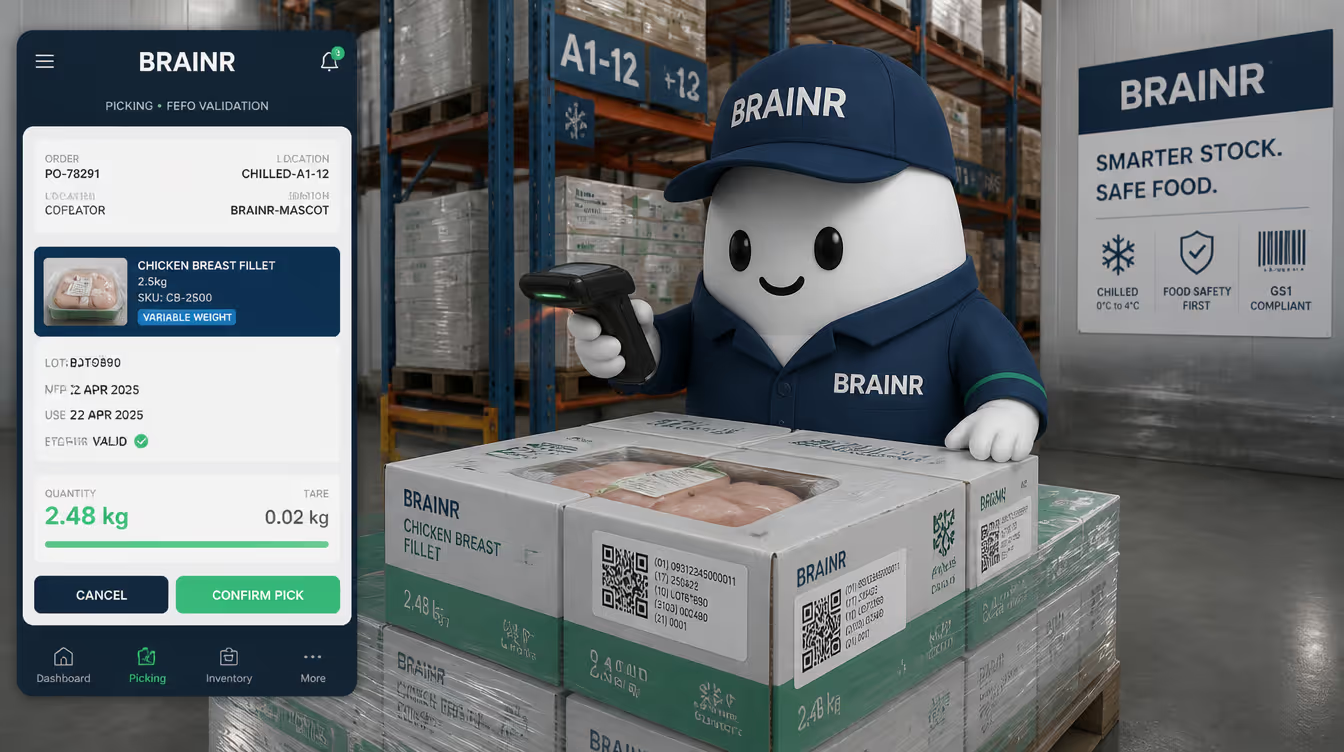
Modern platforms run on mobile devices on the shop floor, including Android tablets and ruggedised handheld scanners, with consistently high adoption rates achieved when the interface is designed for operators rather than office users. Operators scan lots, confirm consumption, register losses and complete quality checks in the same workflow as the production task itself.
5. Yield, waste, and overproduction control
Traceability data is not just for audit defence. It is the foundation for measuring and improving operational performance. Every transformation step generates yield data: how much input went in, how much output came out, how much was lost or reworked.
In food production, especially in meat processing, yield is the single biggest driver of profitability. A platform that captures yield data automatically, without operators stopping to fill forms, turns traceability into operational intelligence.
"Unknown yield waste is what I think to be the biggest waste in the food industry in Europe. Most companies are still operating with Excel and paper as their operating system. We cannot optimise what we cannot measure."
Paulo Gaspar, CEO BRAINR (Webinar Apr 2026)
6. Quality embedded in execution
Quality records are part of traceability, not a parallel system. HACCP critical control points, in-process quality checks, allergen verifications and corrective action records all link to the same lot data that drives traceability. A food traceability program that survives audits is one where quality and traceability share the same data spine. When a recall happens, the quality history of that lot is already attached, not waiting in a separate quality database.
This is where audit-ready operations and reactive operations diverge. Audit-ready manufacturers can demonstrate every check that was performed on every lot, with timestamps and operator IDs, in minutes. Reactive operations spend days reconstructing the same evidence from disconnected sources.
7. ERP integration depth
Modern food traceability software does not replace the ERP. It complements it. The ERP manages orders, financials and master data. The traceability platform manages execution, real-time data and operational reality. The two have to be connected. The problem is that most legacy implementations connect them with overnight batch jobs, which is the technical equivalent of throwing files over a wall.
Strong platforms integrate with ERPs in real time: production orders flow from ERP to the platform, execution data flows back, financial reconciliation happens automatically, and there is no period where the two systems disagree about what is in stock.
Concretely, this means integration through real-time REST APIs and native connectors with major ERPs including SAP, Microsoft Dynamics and Sage. GS1 standards (GTIN, GLN, SSCC) provide a common identification language across systems, so lot codes flow through the supply chain without manual translation, and any partner that reads GS1 reads the data the platform produces.
Want to see how these capabilities work together in a single platform? Explore the BRAINR Traceability module
From slaughterhouse to small-batch fresh: 3 real adaptations
Capabilities matter only when they translate into operational change. Effective food traceability solutions adapt to the operation, not the other way around. Three European food manufacturers, each running fundamentally different operations, show how the same platform handles each profile.
Avisabor (Estarreja, Portugal): high-volume slaughter scaling 4.75x
Avisabor is one of Portugal's largest poultry slaughterhouses, supplying major retailers across Portugal and Spain. The operation combines fully automated lines running without human intervention with traditional lines that depend heavily on manual labour, a complexity that defeats most off-the-shelf platforms.
Before digitisation, Avisabor relied on paper records, multiple Excel sheets, and several legacy software systems that did not communicate. Machines had virtually no integration with management software. At 40,000 birds per day, the operation was already at the limit of what manual coordination could handle.
Implementation took 4 months, end of 2020 to early 2021, with two implementation specialists. Modules deployed sequentially: gatehouse, reception, slaughter, planning, production (slaughter, deboning, trimming, slicing, transformation, packaging), shipping, warehouse, quality. Marel slaughter line integration came as part of the rollout.
Five years later, Avisabor processes 190,000 birds per day, 4.75x the original volume, on the same digital foundation. The numbers behind that scale: 35 production lines, 5,200 lots per month, 5,000 quality controls per month, 2.6 million labels per month, 183 active customers, 350+ SKUs. Average warehouse storage time dropped 50%, primarily because better production planning combined with real-time stock visibility eliminated the inventory buffer the old paper-based process required.
Lusiaves Group (multi-site enterprise, Portugal): 65%+ of national poultry production
Lusiaves Group is one of Europe's largest poultry processors, fully vertically integrated from agriculture to distribution. The group manages over 150 million birds per year across multiple production sites, with corn production and animal feed manufacturing as part of the same operation. Annual revenue exceeds €1 billion. The challenge in this profile is not just data capture, it is poultry traceability that synchronises across multiple sites in real time.
The flagship plant in Marinha das Ondas processes 150,000 birds per day across more than 1,000 SKUs, including Halal production. Until September 2025, factory teams worked with partial information across multiple software systems, and in some cases paper. Decisions across teams were not fully aligned because each team saw a different version of the data.
Integration with BRAINR connected farm operations to factory operations directly. Information from the farms flows automatically (quantities, locations, average weights, breeds), and as slaughter processes, performance feedback flows back: actual weights, rejections, deaths, causes, all per flock and per truck. The result is a closed-loop system that eliminates the manual reconciliation that previously drove errors.
"We saw a clear shift from resistance to ownership and engagement. Many of the improvements come directly from the users themselves."
Diogo Ferreira, Managing Director, Lusiaves Marinha das Ondas (Webinar Apr 2026)
Campoaves Viseu: small-batch high-mix, IFS certified in 4 months
Campoaves Viseu is a different profile entirely. The operation does not have its own slaughterhouse, which means production runs entirely on fresh raw materials with very short shelf life. Every production day starts with incoming stock that has a narrow window. Miss it and the cost is immediate.
The complexity is not volume but mix: many SKUs, many small daily production orders, with planning that must adapt continuously. Before digitisation, the factory relied on verbal communication and paper. Data was recorded by hand and re-entered into Excel, creating compounding problems. Products could often not be traced back to their lot. Incorrect shipments reached customers, adding return costs on top of waste. Non-productive costs (cleanings, set-ups, consumables) were systematically under-recorded, distorting the entire cost picture.
With IFS certification as a target, paper-based processes were not going to get them there.
Implementation took 4 months, March to June 2023, with two specialists. Modules deployed sequentially: gatehouse, reception, planning, production (trimming, deboning, cutting, slicing, packaging), shipping, warehouse, quality. The slaughter module did not apply. SAP ERP integration was part of the rollout.
Outcomes: 21 production lines digitised, 80+ users trained, 40+ devices connected. IFS certification achieved, something that was not achievable with the previous paper-based approach. Quality and traceability reporting time fell 95%. Manual data entry fell 92%. Operational efficiency rose 21%. Shipping errors fell 94%. The labelling integration alone, which replaced manual data entry into label printers with automatic generation from production data, eliminated one of the most error-prone steps in the previous operation.
Three operations. Three profiles: high-volume slaughter, multi-site enterprise, small-batch fresh. Same platform. Same 4-month implementation timeline. The pattern is not coincidence. It is what software designed for food, not adapted to it, looks like in production.
How long does implementation take?
Across Avisabor, Campoaves Viseu, and the initial Lusiaves rollouts, the answer is consistent: 4 months from kickoff to full digitisation, with no production disruption during the rollout.
The timeline holds because of how the implementation is structured.
"Start small and iterate. We split the factory into different sections and take small steps. We implement the software, but not the ideal version. We ask what is the minimum to put this to work, then we jump to the next. Small steps decrease risk and lead to much faster implementations."
Paulo Gaspar, CEO BRAINR (Webinar Apr 2026)
Concretely, this means the factory is divided into operational sections (gatehouse, reception, slaughter if applicable, production, shipping, warehouse, quality), and each section is rolled out sequentially. Operators use the system in a deliberately simplified version first, then improvements come from their feedback as they gain familiarity.
This contrasts sharply with the traditional MES implementation pattern, where projects run 12 to 18 months trying to reach a perfect end-state before going live. The traditional approach has a higher failure rate and delivers no value until completion. The iterative approach delivers operational benefit within weeks of starting.
This timeline assumes alignment between operations and IT teams, willingness to deploy section by section rather than wait for full configuration, and the implementation team working on a defined scope from day one. Implementations that try to redefine processes during rollout, or that lack a single accountable internal owner, take longer.
Two implementation specialists, four months, no production disruption. Across three different profiles of food manufacturer.
Frequently asked questions
What is food traceability?
Food traceability is the practice of tracking food products and their ingredients across every stage of the supply chain, from raw material origin to final consumer. It is a regulatory and operational discipline, not a technology category. Food traceability is what manufacturers must achieve under regulations like FSMA Rule 204 and EU Regulation 178/2002. Food traceability software is the digital tool that makes the practice executable at scale, replacing paper records, spreadsheets and disconnected systems with a single source of truth that captures lot data automatically.
What is the food traceability rule?
FSMA Rule 204 (formally, the FDA's Food Safety Modernization Act Rule on Requirements for Additional Traceability Records for Certain Foods) requires manufacturers handling foods on the Food Traceability List to maintain Key Data Elements at Critical Tracking Events. In practice, this means capturing specific data points (who shipped, who received, when, lot codes, locations) at every transformation, transfer or shipping event. Records must be available to FDA in sortable electronic format within 24 hours of a request.
How does food traceability work?
Food traceability captures and links data at every step a product takes through the supply chain. At ingredient receipt, the system records supplier, lot, certifications and treatment. At each production step, it records inputs, outputs, transformations, equipment used and operators involved. At dispatch, it records customer, route and shipment details. The links between these records form a chain that can be traversed in either direction: backward (what went into this product?) or forward (where did this lot go?).
What is on the FDA Food Traceability List?
The Food Traceability List (FTL) covers categories the FDA identifies as higher-risk for foodborne illness outbreaks: leafy greens; melons; tropical tree fruits; herbs (fresh); peppers (fresh); sprouts; tomatoes (fresh); cucumbers (fresh); shell eggs; finfish; smoked finfish; molluscan shellfish (raw); crustaceans; fresh-cut produce (ready-to-eat); and certain ready-to-eat foods including soft cheeses, deli salads, nut butters, and others. Compliance under FSMA 204 specifically targets these categories, and the full FTL with current updates is maintained on the FDA website.
How long should traceability records be kept?
Under FSMA Rule 204, records must be retained for two years. EU Regulation 178/2002 also requires two years for most food categories. BRC and IFS audits typically require records to be available for the duration of the certification cycle plus the previous certification period. Many food manufacturers keep traceability records longer than required as a matter of operational practice, since modern cloud-based platforms make extended retention essentially free.
Does food traceability software replace the ERP?
No. The ERP manages orders, financials, accounting, and master data. Food traceability software manages execution, real-time operations, lot-level tracking, and quality records. The two are complementary and have to be integrated. A common implementation pattern is: ERP defines what should happen (orders, plans), the traceability platform records what actually happened (execution, transformations, exceptions), and integration ensures the two systems agree on inventory and financials in real time.
Is FSMA Rule 204 still on track for 2026?
The original compliance date of January 2026 has been proposed for extension to July 2028 by the FDA. As of 2026, the extension is in proposed-rule status, meaning the original 2026 date technically remains until the rule is finalised. In practice, most retail buyers and certification bodies are treating compliance-readiness as a current expectation, regardless of regulatory deadline. Manufacturers waiting for finalisation of the rule extension before implementing traceability software are taking on commercial risk that exceeds the regulatory risk.
Ready to see what this looks like in your operation?
Modern food traceability software does not solve every operational challenge in food manufacturing. But a food traceability system that captures lot data automatically, in real time, removes the foundation problem (the absence of trustworthy data) that prevents every other problem from being solved properly.
Whether your operation is high-volume slaughter, multi-site enterprise, or small-batch fresh, the right traceability software for the food industry adapts to how you actually run. Generic systems force the opposite. They are why most digital transformation projects in food deliver less than promised.
If you want to see how a food-native traceability platform handles your specific operation, whether slaughter, processing, fresh-cut, multi-site or single-plant, book a demo with BRAINR.
30 minutes. Walked through with someone who has run a food factory.
Stay Ahead with Fresh Insights
Dive into our blog for stories, lessons, and behind-the-scenes insights from real projects. It’s where we share what’s working — and what we’ve learned along the way.


Frequently asked questions